
Nurse to Tech: Clinical vs Technical Roles in Healthcare Tech (What’s the Difference?)
More and more nurses are exploring healthcare tech careers (especially those looking for non-bedside nursing jobs) but it’s not always clear what that actually means.
The tricky part is that “healthcare tech” isn’t one specific path. It includes a wide range of roles that can look very different day to day.
Some healthcare tech roles keep you closely connected to clinical work (like clinical informatics roles), while others move you further away from patient care and into areas like data, systems, or product development.
Others move you further away from patient care and into areas like data, systems, or product development.
Without understanding the difference, it’s easy to feel stuck - or start working toward a path that doesn’t actually fit what you want.
In this post, we’re breaking down the two main directions in healthcare tech (clinical roles vs. technical roles) so you can start figuring out which one aligns best with your goals, your strengths, and your life right now.
What Is Healthcare Tech? (Careers for Nurses Explained)
Healthcare tech is a broad field that includes any role where healthcare and technology overlap. For nurses, this often shows up as a range of health tech jobsthat combine clinical experience with technology in different ways.
At its core, it’s focused on how technology is used to improve healthcare delivery. Whether that’s through patient care systems, data, operations, or the tools clinicians use every day.
For most nurses exploring this space, healthcare tech shows up in a few main areas:
Electronic health record (EHR) systems like Epic or Cerner
Health tech companies building digital tools or apps
Hospital or health system teams that manage and improve internal technology
Startups focused on improving access, efficiency, or patient experience
What’s important to understand is that you don’t have to be an engineer (or even leave healthcare) to work in this space.
Many roles still rely heavily on clinical experience, while others focus more on data, systems, or product development. That difference is exactly where the clinical vs technical split starts to matter.
→ If you’re exploring healthcare tech careers but aren’t sure how to make the transition, this guide breaks down how nurses can move into tech roles (even without prior tech experience).
Path 1: Clinical Roles in Healthcare Tech
Clinical roles in healthcare tech are often the most natural starting point for nurses exploring non-bedside or tech-focused careers because they build directly on your existing experience.
In these roles, you’re still connected to clinical workflows and patient care. But instead of providing direct bedside care, you’re working with the systems and tools that support it.
A big part of the work is bridging the gap between clinicians and technology teams. In other words, you help make sure the technology actually works for the people using it in real clinical settings.
What These Roles Typically Look Like
In clinical healthcare tech roles, you might be:
Helping implement or optimize EHR systems like Epic or Cerner
Supporting training for nurses, providers, or staff during system updates or “go-lives”
Identifying workflow issues and helping design better processes
Acting as a liaison between clinical teams and IT or vendor teams
Supporting day-to-day use of healthcare technology in a hospital or health system
Common Job Titles You Might See
These types of roles are often grouped under clinical informatics roles or similar titles.
Clinical Informatics Specialist
Nurse Informaticist
Clinical Analyst
Clinical Applications Analyst
EHR Trainer / Clinical Educator (in a tech-focused role)
Implementation Specialist
Why Nurses Often Start Here
For many nurses, this path feels like the most accessible entry point into healthcare tech because:
You’re using your clinical background directly
You already understand workflows, documentation, and patient care processes
There’s often less need for brand new technical skill sets upfront
Many roles exist within health systems (so it can feel like a “lateral move” instead of a full career change)
What The Learning Curve Usually Looks Like
Most clinical tech roles don’t require going back to school, but they do involve learning new systems and ways of thinking.
That learning often happens through:
On-the-job training
Internal transition programs within health systems
EHR certifications or system-specific training (like Epic certifications)
Learning how to translate clinical workflows into system logic
In many cases, you’re not starting over. You’re building on your clinical experience and learning how it applies in a different environment.
What This Change Actually Means Day to Day
While this path can feel like a smoother transition, it’s still a shift:
You’ll spend less time directly at the bedside
Your work becomes more system-focused than patient-facing
Your impact is often indirect, but still very connected to patient care outcomes
Path 2: Technical Roles in Healthcare Tech
Technical roles in healthcare tech are another common path for nurses exploring healthcare tech careers, especially those interested in data, systems, or product work (and moving further away from the bedside).
In these roles, your nursing background is still valuable, but it’s not the main focus of your work. Instead, you’re using transferable skills (like problem-solving, communication, and critical thinking) in a more technical or systems-based environment.
→ If you’re not sure what skills you already bring, you can start here: 7 Transferable Skills Every Nurse Has (and Why They Matter)
What These Roles Typically Look like
In technical healthcare tech roles, you might be:
Analyzing healthcare data to identify trends or improve outcomes
Working on digital products used by patients or clinicians
Managing projects related to system implementations or improvements
Collaborating with engineers, designers, or data teams
Helping build, test, or improve healthcare technology solutions
Common Job Titles You Might See
Healthcare Data Analyst
Product Manager (Health Tech)
Health IT Project Manager
Business Analyst
UX Researcher (Healthcare)
(For more technical paths) Software-related roles
Why Someone Might Choose This Path
This path tends to appeal to nurses who are:
Curious about how systems work behind the scenes
Interested in data, strategy, or building solutions
Looking for more flexibility (including remote opportunities)
Open to stepping further away from traditional clinical roles
It can also offer a higher long-term salary ceiling and a wider range of career paths over time.
What This Change Actually Means Day to Day
Compared to clinical roles:
Your work is less tied to patient care workflows
You’re spending more time working with data, systems, or cross-functional teams
Your impact is often more indirect, but can influence larger systems or populations
Do You Need More Schooling for Technical Roles?
One of the biggest differences with this path is the learning curve.
Most technical roles don’t require going back for another full degree. But they do require learning new, practical skills that aren’t typically part of a nursing role.
What that learning can look like
Online courses (self-paced and flexible)
Certificates (Google, Coursera, etc.)
Learning on the job through internal transitions
Self-teaching combined with small, hands-on projects
Examples of skills you might build
Data tools like Excel, SQL, or (sometimes) Python
Basic data analysis and visualization
Product or systems thinking
Project management frameworks and tools
Instead of thinking about this as going back to school, it’s more helpful to think of it as intentionally building a new skill set.
That might happen gradually, alongside your current role, and doesn’t have to follow a traditional academic path.
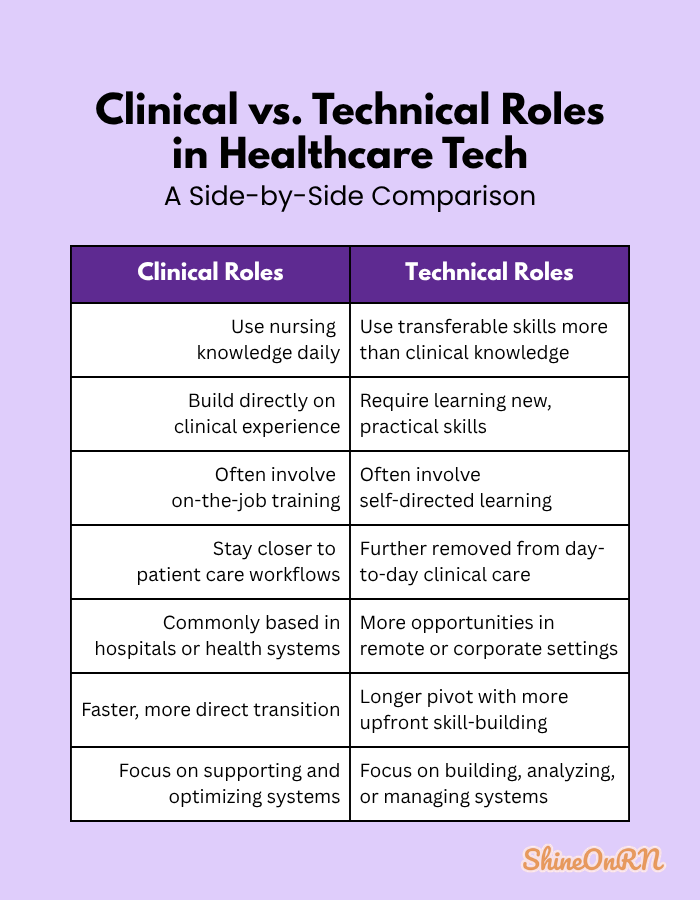
Clinical vs Technical: Side-by-Side Comparison
At this point, you might already have a sense of which direction feels like a better fit—but seeing the differences side by side can make it even clearer.
Here’s a simple breakdown of how these two paths typically compare:
How to read this
As you’re looking at this, pay attention to what stands out to you. Not just what sounds good on paper, but what actually feels like a better fit for your day-to-day work.
How to Decide Which Path Is Right for You
By now, you probably have a sense of which direction feels more interesting. Or at least which one you’re more curious about.
If you’re still unsure which direction to take in your nurse to tech career, try shifting the focus away from job titles and toward how you want your day-to-day work to look.
A Few Questions to Think Through
Do you want to stay closer to patient care, or step further away from it?
Do you enjoy teaching and supporting others, or are you more interested in analyzing, building, or working with systems?
Are you looking for a quicker transition, or are you open to spending time learning something new?
Does learning technical skills sound interesting, or does it feel like a stretch you’re not that interested in?
What to Do With Your Answer
You’re not trying to make a permanent decision here. You’re just picking a direction to explore.
If one side stands out, use that as your starting point. From there, you can:
Look into specific roles in that path
Start noticing what skills come up repeatedly
Get a better sense of what those jobs actually look like
That’s usually enough to move forward.
You Don’t Have to Choose Forever
One last thing to keep in mind: these paths aren’t fixed.
It’s common to start in a clinical role and move into a more technical one over time, or to shift directions as your interests and goals change. The first step you take doesn’t lock you into one path. It just helps you get closer to what fits.
Next Step: Get Clear on Your Direction
If you’re still deciding which path makes the most sense for you, I put together a free Nursing Career Direction Quiz to help you sort through your strengths, interests, and goals.
It’s a simple way to get a clearer starting point. Especially if you’re feeling stuck between a few different options.
Disclaimer: The content shared here is for informational purposes only and is not a substitute for professional medical, financial, or legal advice. Always consult a qualified professional regarding your personal needs.